But yesterday's Cubs game included 3 errors by Cesar Izturis and a couple of misplaced balls by Alfonso "What Position Am I Playing Today" Soriano.
Man, I'd be lining up to buy this team!
Peace
Wednesday, April 11, 2007


Hail to the Blogosphere
I want to thank anonymous for posting a reply to my previous post. He or she help me realize that my language had not been precise enough and I hadn’t given enough back story to why I think that Willie B. Cochran’s election win, coupled with a win for Dorothy Tillman, would spell disaster for the Washington Park community in face of the impending Olympic stadium construction. So here goes. And thanks anonymous, and I hope you post again soon!
There is little evidence that big time events such as the Olympics or stadium construction have tangible economic benefits for the communities they impact. There are 3 reasons for this:
People ignore the reality of substitution when they claim that 500 million or 600 million or some gargantuan sum of money will be spent on the event or at the stadium. Families have fixed leisure budgets. Money spent on the Olympics or inside a stadium is money not spent on other leisure events or outside the stadium
The jobs created by stadium construction, the Olympics, and further stadium events will likely be seasonal, temporary, low wage, high turnover dead end jobs, unless the community mobilizes to make it not so.
The large amount of public funds (150 million from the city and 150 million just pledged by Rod “Don’t Stop Spending” Blago of state funds) used for such projects are generally diverted from more income generating activities or social services.
Losing the Great Meadow of Washington Park is a significant loss for the Washington Park community and the greater Mid-South community. That area is home to baseball, soccer, and cricket leagues, is used for summer festivals such as the Bud Billiken parade, and is an important recreational asset for as strained community. As one South Sider told me, “you take away that space, you’ll see crime double in this neighborhood.”
Dorothy Tillman has shown no skill in parleying large projects (Harold Washington Cultural Center, Jazz District, Federal Empowerment Zone) into community benefits.
While TWO started off as an organization seeking to challenge the status quo (including the university I ambiguously attend) to benefit Woodlawn residents, it has morphed into a social service organization more interested in partnership and “playing the game” then confrontational politics. As anonymous noted, that’s not necessarily a bad thing, but I can’t believe that TWO and the alderman that came out of its ranks is going to be able to challenge the Mayor to provide real community benefits for the Olympic project. This the Mayor’s baby, his legacy, the way he can “go out on top.” An organization that has donated money to his campaign is unlikely going to be able to part ranks with him if the benefits aren’t there.
It’s also not like there aren’t multiple construction projects going on in Woodlawn and Washington Park. The University has faced little pressure to ensure (for example) that its massive construction along 61st Street accrues real benefits to Woodlawn residents. Minority contract stipulations do not necessarily act as a proxy for local community benefits.
So that’s my worry. April 14th (I think) is the big day, and I’m not looking forward to it. Either we find out that Chicago is in the running, and we’re in for a long hard slog to get community benefits, or we find out that we’re not good enough for the Olympics.
Sigh
Peace
There is little evidence that big time events such as the Olympics or stadium construction have tangible economic benefits for the communities they impact. There are 3 reasons for this:
People ignore the reality of substitution when they claim that 500 million or 600 million or some gargantuan sum of money will be spent on the event or at the stadium. Families have fixed leisure budgets. Money spent on the Olympics or inside a stadium is money not spent on other leisure events or outside the stadium
The jobs created by stadium construction, the Olympics, and further stadium events will likely be seasonal, temporary, low wage, high turnover dead end jobs, unless the community mobilizes to make it not so.
The large amount of public funds (150 million from the city and 150 million just pledged by Rod “Don’t Stop Spending” Blago of state funds) used for such projects are generally diverted from more income generating activities or social services.
Losing the Great Meadow of Washington Park is a significant loss for the Washington Park community and the greater Mid-South community. That area is home to baseball, soccer, and cricket leagues, is used for summer festivals such as the Bud Billiken parade, and is an important recreational asset for as strained community. As one South Sider told me, “you take away that space, you’ll see crime double in this neighborhood.”
Dorothy Tillman has shown no skill in parleying large projects (Harold Washington Cultural Center, Jazz District, Federal Empowerment Zone) into community benefits.
While TWO started off as an organization seeking to challenge the status quo (including the university I ambiguously attend) to benefit Woodlawn residents, it has morphed into a social service organization more interested in partnership and “playing the game” then confrontational politics. As anonymous noted, that’s not necessarily a bad thing, but I can’t believe that TWO and the alderman that came out of its ranks is going to be able to challenge the Mayor to provide real community benefits for the Olympic project. This the Mayor’s baby, his legacy, the way he can “go out on top.” An organization that has donated money to his campaign is unlikely going to be able to part ranks with him if the benefits aren’t there.
It’s also not like there aren’t multiple construction projects going on in Woodlawn and Washington Park. The University has faced little pressure to ensure (for example) that its massive construction along 61st Street accrues real benefits to Woodlawn residents. Minority contract stipulations do not necessarily act as a proxy for local community benefits.
So that’s my worry. April 14th (I think) is the big day, and I’m not looking forward to it. Either we find out that Chicago is in the running, and we’re in for a long hard slog to get community benefits, or we find out that we’re not good enough for the Olympics.
Sigh
Peace
Thursday, April 05, 2007
Chicago Politrix
We're lurching towards a run-off election here in Chi-city on April 17th. The amount I care about these things is probably somewhat disproportionate to how much I should, but I do have a couple of "dogs" in some races. The continuing labor vs. Mayor Daley's machine battle, a continuation of the summer's big box wage ordinance fight is the most exciting development in local politics since the Harold Washington administration. The 3rd Ward race, with former New Yorker turned SSA field coordinator Pat Dowell running against Dorothy "the Hat" Tillman is even more important now that the 20th Ward is represented by Willie "Bishop Brazier/TWO/Leon Finney" Cochran. If Tillman wins, then the neighborhood like most affected by the Washington Park will be represented by a front for the 63rd Street machine (closely connected to mayor daley through donations and city development aid) and crazy Dorothy. Bad news for the community, good news for those who want to construct a giant white elephant in Washington Park without resistance.
I'll let these excellent posts from Richard Carnahan and Chicagoist speak for me. Happy Holy Week
Don't Let the Games Begin, Richard Carnahan, Gapers Block
Making a New Deal, Chicagoist
Peace
I'll let these excellent posts from Richard Carnahan and Chicagoist speak for me. Happy Holy Week
Don't Let the Games Begin, Richard Carnahan, Gapers Block
Making a New Deal, Chicagoist
Peace
Wednesday, April 04, 2007
It Takes An Outsourced Nation to Hold Me Back
Yet again, the Monk is back. This time, I have a somewhat valid excuse: Dell's wonderful outsourced refurbished computer department.
See, our family doesn't do laptops well. In five years, we've gone through three of them. Part of that comes from living in the dust/mold bowl of Guatemala, part of it comes from the "convenience" of being able to do email while eating ribs (gooey rib sauce is not good for an operating system, apparently). A bonanza of a Christmas when I received Madden football (good looking out Drew!) and a used I-Pod obviously led to our Toshiba laptop committing suicide rather than putting out the required processing power.
Luckily, one of our best friends in Hyde Park is a super-technofile (and a woman: raise your fist and march around Carol Haney!). So one Sunday after church Sarah and Carol spent some time ordering a wonderful refurbished computer from Dell. Just so you have a sense of chronology, this was early January. That Thursday, a box arrived from Dell Computers. Actually, two boxes came. With two monitors. One for a fellow in Louisana, and one for a guy in New York. Hmmm. The next day, two CPU towers arrived. Interesting. And the following day, two sound bars arrived. Now, maybe you're thinking, great Jack, you're a masters-soon to be doctoral student, you can certainly afford two computers. What's the problem?
Unfortunately, that was the attitude of the lovely Indian folks we talked to and talked to and talked to on the phone for the following week. Between staticy phone lines, stress causing me to fall into my New York accent and difficulty understanding Hindi-accented English, the fit hit the shan so to speak. To be succinct, our credit card was charged for 2 complete computer systems we did not order. And the outsourced Dell help could not get what the problem was or why we weren't checking our email.
Carol was gracious enough to lend us her tablet pc with a monitor and keyboard, so we were at least able to check email for the time being. But it did cramp my blogging style a bit, as it lacked the processor speed, etc. to do this justice. The happy ending is that we got a computer (ordered through the University: they're sucking me in further!!!) and the Monk is back.
The bigger point is that I'm not alone in being frustrated with outsourcing. There is an inherent contradiction between the dominant business model operating in the American economy and the desire for employees to "add value" to their work. The dominant business model says that to be competitive, American companies must ruthlessly cut costs, especially the costs of front line workers. Which is why wages for front line service workers have stagnated, many companies manipulate the hours and days worked of employees as if they were widgets, not people with lives, and companies like Dell outsource tech help and other customer service positions. The major problem with this focus on competition through cost-cutting (and not competition through quality) is that you can't treat labor like a commodity and expect them to add a lot of value to their work.
Cattle, soybeans, crude oil and corn are commodities. You raise them, mine them, extract them, and then put them into a process that adds value to them. There is little an ear of corn can do to add value to itself on its own. It makes sense for companies to reduce the cost of commodity inputs since one ear of corn or one bushel of soybeans is relatively the same as any other. People generally don't work like that, especially if you want your employees to provide cheerful, competent customer service. For companies to pay people poorly, schedule them haphazardly so they have no idea when they'll be working from week to week, provide them with little benefits or power over their work lives and to then expect high quality work is just dumb.
I want to be clear that the phenomenon of outsourcing is a complex one and my critique here is limited to the specifics I've outline above. I'm much more concerned about the business model and the quality of front line service jobs that facilitates outsourcing, not outsourcing itself. Well, it's good to be back. Peace
See, our family doesn't do laptops well. In five years, we've gone through three of them. Part of that comes from living in the dust/mold bowl of Guatemala, part of it comes from the "convenience" of being able to do email while eating ribs (gooey rib sauce is not good for an operating system, apparently). A bonanza of a Christmas when I received Madden football (good looking out Drew!) and a used I-Pod obviously led to our Toshiba laptop committing suicide rather than putting out the required processing power.
Luckily, one of our best friends in Hyde Park is a super-technofile (and a woman: raise your fist and march around Carol Haney!). So one Sunday after church Sarah and Carol spent some time ordering a wonderful refurbished computer from Dell. Just so you have a sense of chronology, this was early January. That Thursday, a box arrived from Dell Computers. Actually, two boxes came. With two monitors. One for a fellow in Louisana, and one for a guy in New York. Hmmm. The next day, two CPU towers arrived. Interesting. And the following day, two sound bars arrived. Now, maybe you're thinking, great Jack, you're a masters-soon to be doctoral student, you can certainly afford two computers. What's the problem?
Unfortunately, that was the attitude of the lovely Indian folks we talked to and talked to and talked to on the phone for the following week. Between staticy phone lines, stress causing me to fall into my New York accent and difficulty understanding Hindi-accented English, the fit hit the shan so to speak. To be succinct, our credit card was charged for 2 complete computer systems we did not order. And the outsourced Dell help could not get what the problem was or why we weren't checking our email.
Carol was gracious enough to lend us her tablet pc with a monitor and keyboard, so we were at least able to check email for the time being. But it did cramp my blogging style a bit, as it lacked the processor speed, etc. to do this justice. The happy ending is that we got a computer (ordered through the University: they're sucking me in further!!!) and the Monk is back.
The bigger point is that I'm not alone in being frustrated with outsourcing. There is an inherent contradiction between the dominant business model operating in the American economy and the desire for employees to "add value" to their work. The dominant business model says that to be competitive, American companies must ruthlessly cut costs, especially the costs of front line workers. Which is why wages for front line service workers have stagnated, many companies manipulate the hours and days worked of employees as if they were widgets, not people with lives, and companies like Dell outsource tech help and other customer service positions. The major problem with this focus on competition through cost-cutting (and not competition through quality) is that you can't treat labor like a commodity and expect them to add a lot of value to their work.
Cattle, soybeans, crude oil and corn are commodities. You raise them, mine them, extract them, and then put them into a process that adds value to them. There is little an ear of corn can do to add value to itself on its own. It makes sense for companies to reduce the cost of commodity inputs since one ear of corn or one bushel of soybeans is relatively the same as any other. People generally don't work like that, especially if you want your employees to provide cheerful, competent customer service. For companies to pay people poorly, schedule them haphazardly so they have no idea when they'll be working from week to week, provide them with little benefits or power over their work lives and to then expect high quality work is just dumb.
I want to be clear that the phenomenon of outsourcing is a complex one and my critique here is limited to the specifics I've outline above. I'm much more concerned about the business model and the quality of front line service jobs that facilitates outsourcing, not outsourcing itself. Well, it's good to be back. Peace
Monday, January 22, 2007
Shiny and New
(Editor’s Note: The monk is back. Postings will now regularly occur on Mondays, Wednesdays and Fridays. Stay tuned for a redesign/upgrade guided by Mike Doyle of chicagocarless.com )
Living in Hyde Park and moving through the mid-South side brings concrete reality to lofty phrases like urban renewal and redevelopment. I’ve lost count of how many times I’ve been impressed with the architectural beauty of certain blocks out south and how many times I’ve seen a cookie cutter cement block condo complex rising next to an abandoned brick masterpiece. I just had the good fortune of reading Richard Nickel's Chicago: Photographs of a Lost City by Richard Cahan and Michael Williams. The beautiful buildings Nickel was unable to prevent from being reduced to photographic memories and rubble stunned Sarah and I. Somewhat fittingly, I was reading John Teafords, Rough Road to Renaissance, a book about the history of urban redevelopment from the 1940s on at the same time. I was struck by the cult of newness that seems to have shaped American urban society since at least the 1940s. Cities began their decline because folks were tired of the grey or brown bricks of Louis Sullivan masterpieces and longed for shiny new Mies van derRoe monstrosities. I know I’m not the first to point this out, but the drive for newness that has removed some of Chicago’s most beautiful and unique buildings from its skyline and neighborhoods is something of obsession in American life and public policy. Public housing having problems? Tear it down. Hurricane Katrina reveal problems of race and spacial segregation in American cities? Let’s tear it down and start over. Relationship not working out? Drop her like it’s hot.
Renovation, renewal and rehabilitation are harder, sometimes more expensive and lead to unpredictable results. And I certainly don’t want to give into the conservatism of the past. But there’s got to be some way to overcome this American obsession with newness and all its destructiveness.
Living in Hyde Park and moving through the mid-South side brings concrete reality to lofty phrases like urban renewal and redevelopment. I’ve lost count of how many times I’ve been impressed with the architectural beauty of certain blocks out south and how many times I’ve seen a cookie cutter cement block condo complex rising next to an abandoned brick masterpiece. I just had the good fortune of reading Richard Nickel's Chicago: Photographs of a Lost City by Richard Cahan and Michael Williams. The beautiful buildings Nickel was unable to prevent from being reduced to photographic memories and rubble stunned Sarah and I. Somewhat fittingly, I was reading John Teafords, Rough Road to Renaissance, a book about the history of urban redevelopment from the 1940s on at the same time. I was struck by the cult of newness that seems to have shaped American urban society since at least the 1940s. Cities began their decline because folks were tired of the grey or brown bricks of Louis Sullivan masterpieces and longed for shiny new Mies van derRoe monstrosities. I know I’m not the first to point this out, but the drive for newness that has removed some of Chicago’s most beautiful and unique buildings from its skyline and neighborhoods is something of obsession in American life and public policy. Public housing having problems? Tear it down. Hurricane Katrina reveal problems of race and spacial segregation in American cities? Let’s tear it down and start over. Relationship not working out? Drop her like it’s hot.
Renovation, renewal and rehabilitation are harder, sometimes more expensive and lead to unpredictable results. And I certainly don’t want to give into the conservatism of the past. But there’s got to be some way to overcome this American obsession with newness and all its destructiveness.
Monday, November 20, 2006
White Elephants in the Outfield
So the Chicago Cubs have signed Alfonso Soriano to the largest contract in Cubs history and the fifth highest in MLB history. Jay Marriotti seems to think (as do many others) that this is a sign of the Cubs making real moves to re-establish themselves as the Chicago baseball team. Marriotti can't help but take a dig at the only baseball team in Chicago to win a world series in the last hundred years, saying that this shows up Kenny Williams and the White Sox. The Cubs are back and can make a run at the NL Central, right?
Bupkiss. Alfonso Soriano is coming off a fantastic season with the Nationals and is a good player. He is not worth 136 million dollars and he certainly will not be worth even close to that at the middle of, let alone the end of this multi-year deal. This deal will cement the Cubs as losers. Why? Because their two big signings this winter are the anti-David Ortiz/Derek Jeters.
Trust me. I watched Soriano in NY and he choked big time in the offseason. Keith Olberman said it best on Dan Patrick's radio show yesterday: Soriano feasts on bad pitching, but when facing good pitching: 0-4. I had A-Ram on my fanstasy team the last two years. Both times I picked him with a high pick. Both times I watched him do really well when it didn't matter (like the beginning of our fantasy season when everyone pulled away from me) and tank whenever the Cubs were in contention. And now besides having the worst rotation in all of baseball (who's pitching behind Zambrano: will they put together 15 injured pitchers in the hope they can get a game a month out of each?) and the worst pitching coach in baseball history, the Cubs just got significantly worse in the field. A-Ram is the worst fielding third baseman I've ever seen. He has pop-ups bounce off his head. The Cubs outfield is now going to be Jacque Jones, Matt Murton, and Soriano? Wow. Let me tell you from observing the White Sox in 2005 and in 2006. Centerfielders matter (where have you gone Aaron Rowand!!!) If you're going to have a terrible pitching staff, having a terrible fielding team is adding nitroglycerine to an already raging car fire.
Bad news. Throw temper tantrum Lou Pinella in and at least it'll be interesting on the North Side next year.
Go Sox
Peace
Bupkiss. Alfonso Soriano is coming off a fantastic season with the Nationals and is a good player. He is not worth 136 million dollars and he certainly will not be worth even close to that at the middle of, let alone the end of this multi-year deal. This deal will cement the Cubs as losers. Why? Because their two big signings this winter are the anti-David Ortiz/Derek Jeters.
Trust me. I watched Soriano in NY and he choked big time in the offseason. Keith Olberman said it best on Dan Patrick's radio show yesterday: Soriano feasts on bad pitching, but when facing good pitching: 0-4. I had A-Ram on my fanstasy team the last two years. Both times I picked him with a high pick. Both times I watched him do really well when it didn't matter (like the beginning of our fantasy season when everyone pulled away from me) and tank whenever the Cubs were in contention. And now besides having the worst rotation in all of baseball (who's pitching behind Zambrano: will they put together 15 injured pitchers in the hope they can get a game a month out of each?) and the worst pitching coach in baseball history, the Cubs just got significantly worse in the field. A-Ram is the worst fielding third baseman I've ever seen. He has pop-ups bounce off his head. The Cubs outfield is now going to be Jacque Jones, Matt Murton, and Soriano? Wow. Let me tell you from observing the White Sox in 2005 and in 2006. Centerfielders matter (where have you gone Aaron Rowand!!!) If you're going to have a terrible pitching staff, having a terrible fielding team is adding nitroglycerine to an already raging car fire.
Bad news. Throw temper tantrum Lou Pinella in and at least it'll be interesting on the North Side next year.
Go Sox
Peace
Friday, November 17, 2006
The Best Pizza.. in Chicago(land)
I've decided that I've got to live with the fact that pizza is not an ontological category. It can be adapted to different cultures, can have different ingredients, styles and forms and still be fundamentally pizza (I will still never eat a Hawaiian pizza, though). Chicago has a pizza tradition that I guess is a old and storied as New York's and I live here, so I've got to get used to it. I've also decided that I've had the best pizza in Chicago(land), even though I haven't eaten everywhere.
The gold standard for pizza in my mind is either Gino's in Rockville Centre or Vincent's in Lynbrook, but that may just be for nostaglia reasons. Regardless of the effects of the glow of memory, I often grave the 16in flopply gooey goodness of a good New York pizza. This craving can not be cured by Giordano's, Home Run Inn, Bacci's, Gino's East, Edwardo's, Aurelios, Rosati's, Pizzza Capri or other pizza joints here in Chi-city and the 'burbs. And while my favorite pizza in Chicago(land) is not a thin crust masterpiece like Vincent cooks up, its darn good. It's similar to Edwardo's in that it's not the giant tilt your jaw open pie of Giordano's, but not the square cut thin crust of Aurelio's or Home Run Inn. Luisa's on 139 and Cicero (yes Mike Doyle that's actually in Chicagoland) in Crestwood.
The crust: fantastic: crunchy, buttery, like a good pan pizza from Pizza Hut, only 50 time tastier and more consistent
The sauce: deliciously different: sort of sweet, but not cloying (Yes, my food reviewing skills could use some work).
The cheese: it's pizza cheese, come on, you know it's good.
It's a trek to Luisa's from Woodlawn, and so we don't go that often. Our car happened to be getting fixed at the wonderful J & J Auto Rebuilders on 137th in Crestwood (I hope you never need for their services, but if you do, they are incredible kind and excellent at their jobs). Two blocks away: Luisa's, were a grouchy old Italian lady (Luisa) will move you along with your take out order if you're watching the TV too long. We've done takeout, eaten at the place (great and attentive wait staff: although they do cocktail glasses for their sodas, not a fan), and generally love it.
The best pizza in Chicago(land). Luisa's. Here's metromix's and roadfood.com's take on it.
Peace
The gold standard for pizza in my mind is either Gino's in Rockville Centre or Vincent's in Lynbrook, but that may just be for nostaglia reasons. Regardless of the effects of the glow of memory, I often grave the 16in flopply gooey goodness of a good New York pizza. This craving can not be cured by Giordano's, Home Run Inn, Bacci's, Gino's East, Edwardo's, Aurelios, Rosati's, Pizzza Capri or other pizza joints here in Chi-city and the 'burbs. And while my favorite pizza in Chicago(land) is not a thin crust masterpiece like Vincent cooks up, its darn good. It's similar to Edwardo's in that it's not the giant tilt your jaw open pie of Giordano's, but not the square cut thin crust of Aurelio's or Home Run Inn. Luisa's on 139 and Cicero (yes Mike Doyle that's actually in Chicagoland) in Crestwood.
The crust: fantastic: crunchy, buttery, like a good pan pizza from Pizza Hut, only 50 time tastier and more consistent
The sauce: deliciously different: sort of sweet, but not cloying (Yes, my food reviewing skills could use some work).
The cheese: it's pizza cheese, come on, you know it's good.
It's a trek to Luisa's from Woodlawn, and so we don't go that often. Our car happened to be getting fixed at the wonderful J & J Auto Rebuilders on 137th in Crestwood (I hope you never need for their services, but if you do, they are incredible kind and excellent at their jobs). Two blocks away: Luisa's, were a grouchy old Italian lady (Luisa) will move you along with your take out order if you're watching the TV too long. We've done takeout, eaten at the place (great and attentive wait staff: although they do cocktail glasses for their sodas, not a fan), and generally love it.
The best pizza in Chicago(land). Luisa's. Here's metromix's and roadfood.com's take on it.
Peace
Sunday, November 12, 2006
Call Me A Lou Dobbs Democrat, Then
I'm not the only one who recognizes the economic import of this election. Both the blogosphere and the New York Times (!) recognize the pro-labor, anti new economy nature of the new Democractic majority. It's also interesting how the Times talks about many of these candidates bucking the conventional Democratic wisdom that what undid their majority in Congress and Clinton's presidency was the botched attempt at health care reform. I think these new democratic congresspeople and Senators are right. What destroyed the Clinton presidency and the democratic majorities in Congress was NAFTA. Theda Skopol talks about how a focus on NAFTA ruined Clinton's momentum on health care reform, but more fundamentally, the focus on passing NAFTA opened up the Democrats to attacks from social conservatives. Remember that in 1992, Ross Perot won 15% of the votes because of his opposition to free trade and current economic policy. Then comes the first major policy initiative of the Clinton presidency, a free trade agreement opposed by unions, blue collar workers, and rural americans (the same ones who switched to Democrats this fall).
I imagine most people being shived by the "new economy" looked at this situation and saw a major betrayal of the New Deal and the American dream. So why not vote your social and religious values, instead of still voting for the party that claimed to represent your economic interests, but acted differently. In other words, 1994 was like 2006 in one respect: the Democrats core constituency actedmuch like James Dobson and other Christian conservatives have talked about acting recently: if they take our votes for granted and don't move forward on our issues, what's the point of voting for them?
Peace
I imagine most people being shived by the "new economy" looked at this situation and saw a major betrayal of the New Deal and the American dream. So why not vote your social and religious values, instead of still voting for the party that claimed to represent your economic interests, but acted differently. In other words, 1994 was like 2006 in one respect: the Democrats core constituency actedmuch like James Dobson and other Christian conservatives have talked about acting recently: if they take our votes for granted and don't move forward on our issues, what's the point of voting for them?
Peace
Wednesday, November 08, 2006
The Glass is Half Full
I'm cautiously optomistic about the results of the elections. Granted, Bobby Rush (despite one of my first votes for a Republican in my life), Todd Stroger, and James Houlihan did not lose and I'm not so sure I'm stoked about a Nancy Pelosi-Harry Reid led Democratic Party, but things are still good. Donald Rumsfeld: gone. Ricky Santorum: Gone. Conrad Burns: Gone. Richard Pombo: gone. I would have liked to have seen Tammy Duckworth win and am disappointed that Harold Ford didn't, but I like the Democrats coming into Congress.
Yes, a liberal Democratic is happy about the moderate, socially conservative Democratics elected. I'm sure the media will spin spin and spin some more about the conservatism of the Democrats elected, but if you really look at people like John Tester and Sherrod Brown, it's a more complicated story. As Joe Conanson notes in salon.com, these men and women are economic populists whose wins validated the What's the Matter with Kansas" thesis of Republican dominance (for an unsympathetic reading of this trend, see this article in slate.com). These winning Democrats spoke to people's legitimate fears and anxieties about the "New Economy." What upper middle class intelligentsia types (myself included) don't realize is that the New Economy that so benefits them is killing the broad middle class that used to exist in America. We're rapidly created a Third Worldish, two-tiered economy in which the hyper rich, globalist, hyper-educated urban elite are served by an increasingly larger low wage economy. Conservatives have been able to tap into this anger by framing it as a "heartland" vs. "costal" values issue. What the Browns, Testers, and McCaskills have done is broke open that frame: it's not just about effete snobbish values. It's about the public policies that are facilitating this erosion of the middle class.
I'm excited about the possibilities. All of a sudden we've got people in the Senate, in Congress, who can talk honestly about the economic hollowing out of middle america without being vulnerable to attacks on gay marriage, abortion or whatever "issue de jour" the cynical manipulators of the right come up with. I'm hoping that Democrats take this opportunity to reveal the true nature of the right and its program for America.
Of course, do I think Nancy Pelosi, Harry Reid, New Democrat Rahm Emanuel and Chuckie Schumer can do it?
Oh boy
Peace
Yes, a liberal Democratic is happy about the moderate, socially conservative Democratics elected. I'm sure the media will spin spin and spin some more about the conservatism of the Democrats elected, but if you really look at people like John Tester and Sherrod Brown, it's a more complicated story. As Joe Conanson notes in salon.com, these men and women are economic populists whose wins validated the What's the Matter with Kansas" thesis of Republican dominance (for an unsympathetic reading of this trend, see this article in slate.com). These winning Democrats spoke to people's legitimate fears and anxieties about the "New Economy." What upper middle class intelligentsia types (myself included) don't realize is that the New Economy that so benefits them is killing the broad middle class that used to exist in America. We're rapidly created a Third Worldish, two-tiered economy in which the hyper rich, globalist, hyper-educated urban elite are served by an increasingly larger low wage economy. Conservatives have been able to tap into this anger by framing it as a "heartland" vs. "costal" values issue. What the Browns, Testers, and McCaskills have done is broke open that frame: it's not just about effete snobbish values. It's about the public policies that are facilitating this erosion of the middle class.
I'm excited about the possibilities. All of a sudden we've got people in the Senate, in Congress, who can talk honestly about the economic hollowing out of middle america without being vulnerable to attacks on gay marriage, abortion or whatever "issue de jour" the cynical manipulators of the right come up with. I'm hoping that Democrats take this opportunity to reveal the true nature of the right and its program for America.
Of course, do I think Nancy Pelosi, Harry Reid, New Democrat Rahm Emanuel and Chuckie Schumer can do it?
Oh boy
Peace
Monday, October 30, 2006
The Yacking Has Begun
Whether or not the Democrats pick up control of either House is still up for grabs, as I imagine anyone who is alive knows. But the chattering classes have already begun to spin any Democrat victory not as a repudiation of conservatism (which is may or may not be) but rather as the Democrats becoming more conservative (check out this article in the famously liberal NY Times) or merely because the Republicans somehow went liberal on us (Dick Armey's interpretation-- glad to see he's back and grumbling).
There are hints of an alternate reality in the Times piece at least, where part of Heath Schuler's appeal to voters in a socially conservative North Carolina district are the increasing economic difficulties of the working class. But that doesn't fit the mainstream media's Herculean effort to convince us that only moderates who skew right can win elections now a days in the new economic and political reality they have defined for us.
There are hints of an alternate reality in the Times piece at least, where part of Heath Schuler's appeal to voters in a socially conservative North Carolina district are the increasing economic difficulties of the working class. But that doesn't fit the mainstream media's Herculean effort to convince us that only moderates who skew right can win elections now a days in the new economic and political reality they have defined for us.
Been a Long Time, Been a Long, Lonely, Lonely Time
It's been a long time since I've posted anything of worth, which has probably slowed "Monk-mentum" quite a bit. But for the various one or two people who still check out this blog every so often, let me guide you to sevendaysatminimumwage.org. It's a campaign being run by ACORN and AFL-CIO (!!!) to get the issue of low-wage labor back into the political discussion. Whether the blog-o-sphere can affect massive change is an open question (at least for this blogger) but the stories (a number of the best ones collected by Chicago Carless's Mike Doyle) are riveting and gut-wrenching.
I'm often skeptical of "There are no Children Here" esque social criticism, that attempts to put a "human face" on poverty and other social issues. These accounts can often have the odor of individual pathology that allows readers to avoid asking the real and hard questions of systemic injustice and bad policy as opposed to bad behaviors and bad circumstances. Seven days, and especially the Mike Doyle interviews, strenously avoid that trap. The articulate women interviewed by Doyle frimly grasp that they are trapped in what is more and more the reality of the post-industrial economy in the United States (if you don't believe this to be the case, ask me and I'll send you some of the research on this).
We are rapidly moving towards a two-tiered labor force: the highly paid workers jet-setting through the global economy and the low wage workers who serve them. Moving up from low wage to medium wage to medium high wages is becoming less and less of a possibility because of the disintegration of what are called internal labor markets or job ladders in firms. While we've been distracted by intern oral sex, wars in the Middle East, and a booming stock market, the strong middle class job generating economy that sustained the United States in the 20th century is disappearing.
This is not an inevitable economic pattern nor is it necessarily make good macro-economic sense. Which is why campaigns such as Seven Days are so important. I'm becoming more and more convinced that the heart of social justice is economic justice. While a higher minimum wage won't solve these issues, it's a great first step on the high road to economic development. We've seen the low road, and boy is it wanting.
I'm often skeptical of "There are no Children Here" esque social criticism, that attempts to put a "human face" on poverty and other social issues. These accounts can often have the odor of individual pathology that allows readers to avoid asking the real and hard questions of systemic injustice and bad policy as opposed to bad behaviors and bad circumstances. Seven days, and especially the Mike Doyle interviews, strenously avoid that trap. The articulate women interviewed by Doyle frimly grasp that they are trapped in what is more and more the reality of the post-industrial economy in the United States (if you don't believe this to be the case, ask me and I'll send you some of the research on this).
We are rapidly moving towards a two-tiered labor force: the highly paid workers jet-setting through the global economy and the low wage workers who serve them. Moving up from low wage to medium wage to medium high wages is becoming less and less of a possibility because of the disintegration of what are called internal labor markets or job ladders in firms. While we've been distracted by intern oral sex, wars in the Middle East, and a booming stock market, the strong middle class job generating economy that sustained the United States in the 20th century is disappearing.
This is not an inevitable economic pattern nor is it necessarily make good macro-economic sense. Which is why campaigns such as Seven Days are so important. I'm becoming more and more convinced that the heart of social justice is economic justice. While a higher minimum wage won't solve these issues, it's a great first step on the high road to economic development. We've seen the low road, and boy is it wanting.
Wednesday, September 27, 2006
Here we go again
Hizzoner has shown once again how much he cares about the black community by proposing that Chicago's Olympic Stadium be built in "downtrodden" (Chicago Tribune) and "frayed" (Sun-Times) Washington Park on the South Side.
Here we go again. Washington Park is NOT a frayed, downtrodden park. It is not Douglas Park or Humbodlt Park, the large parks most yuppie decision and opinion makers are familiar with. It is not a breeder of crime and drug sales and is heavily used by members of surrounding communities and is an important meeting space and asset for the Mid-South Side. Yet again, Daley is showing his uncanny ability to exploit the structures of race and exclusion to push through his pet projects. I'm positive that opponents of the stadium (which has been described as collapsible... !) will be painted as pie-in-the sky hippe greenies who are blocking economic development for the South Side.
And again, the Mayor and his bootlackers will be wrong. Stadiums do not necessarily provide immediate or even long or short term benefit to surrounding neighborhoods (US Cellular anybody?) . The beautiful Great Meadow of Washington Park is a community asset that would be destroyed by the collapsible stadium (are we talking about pick-up stick construction?). I'm neither solidly pro nor anti stadium. What I would like to see, and what the racial reality and political machinations of the Mayor prevent, is an honest debate that takes into account the real costs and benefits of such a project.
Peace
Here we go again. Washington Park is NOT a frayed, downtrodden park. It is not Douglas Park or Humbodlt Park, the large parks most yuppie decision and opinion makers are familiar with. It is not a breeder of crime and drug sales and is heavily used by members of surrounding communities and is an important meeting space and asset for the Mid-South Side. Yet again, Daley is showing his uncanny ability to exploit the structures of race and exclusion to push through his pet projects. I'm positive that opponents of the stadium (which has been described as collapsible... !) will be painted as pie-in-the sky hippe greenies who are blocking economic development for the South Side.
And again, the Mayor and his bootlackers will be wrong. Stadiums do not necessarily provide immediate or even long or short term benefit to surrounding neighborhoods (US Cellular anybody?) . The beautiful Great Meadow of Washington Park is a community asset that would be destroyed by the collapsible stadium (are we talking about pick-up stick construction?). I'm neither solidly pro nor anti stadium. What I would like to see, and what the racial reality and political machinations of the Mayor prevent, is an honest debate that takes into account the real costs and benefits of such a project.
Peace
Saturday, September 16, 2006
Three Gritos for La Villita
Last night was the “Grito” a party in celebration of Mexican Independence Day. Mike Rodriquez took myself and two other SSAers down to 26th Street to participate in the annual cantina crawl put on by members of the community. I’m not sure where I would rank it on experiences I’ll save on my mental hard drive for eternity, but halfway through the night, I found myself shaking my head in wonder at my good fortune.
Crammed into a corner bar on 26th and Lawndale was the entire progressive Mexican leadership of Little Village. Chewy Garcia of LVCDC and a veteran independent politician in Chicago was greeting people at the door. Jamie De Leon, the NCP organizer for Little Village was smiling more than I’ve ever seen him before. The last great hope of the Little Village Violence Prevention Collaborative was telling me he loved me. Young, 1st and 2nd generation, college educated, progressive activists were getting down to some of the best live Latin jazz I’ve heard in a long time.
And Alderman Munoz, perhaps the most progressive and independent alderman in Chicago was buying me a beer.
26th Street has always been for me the grown up and responsible older brother of 18th Street in Pilsen. It doesn’t have the trendy art galleries, bars, book stores and night life. It’s the place you go to buy groceries, clothes for your kids and have tacos. 26th Street last night was alive with the pride and strength of the Mexican immigrant community in Chicago. Cars and pick-ups filled with people waved the Mexican flag shouting and honking at each other and pedestrians. The less fortunate rode by on their bikes and rang bells or clown horns. Gang bangers donned non-color coordinated clothes and mixed into the crowd.
And in Jacaranda, the best and the brightest, the strongest hope for an end to the violence tearing the community apart and an independent small-d democratic politics in the City of Chicago were all getting down to Oye Como Va and My Cheri Amor latin style.
When you step out of your comfort zone and the fixed paths given to you by society because of your privilege, skin color or class, life is beautiful.
Viva Mexico! Viva La Villita! Viva la gente luchadora!
Crammed into a corner bar on 26th and Lawndale was the entire progressive Mexican leadership of Little Village. Chewy Garcia of LVCDC and a veteran independent politician in Chicago was greeting people at the door. Jamie De Leon, the NCP organizer for Little Village was smiling more than I’ve ever seen him before. The last great hope of the Little Village Violence Prevention Collaborative was telling me he loved me. Young, 1st and 2nd generation, college educated, progressive activists were getting down to some of the best live Latin jazz I’ve heard in a long time.
And Alderman Munoz, perhaps the most progressive and independent alderman in Chicago was buying me a beer.
26th Street has always been for me the grown up and responsible older brother of 18th Street in Pilsen. It doesn’t have the trendy art galleries, bars, book stores and night life. It’s the place you go to buy groceries, clothes for your kids and have tacos. 26th Street last night was alive with the pride and strength of the Mexican immigrant community in Chicago. Cars and pick-ups filled with people waved the Mexican flag shouting and honking at each other and pedestrians. The less fortunate rode by on their bikes and rang bells or clown horns. Gang bangers donned non-color coordinated clothes and mixed into the crowd.
And in Jacaranda, the best and the brightest, the strongest hope for an end to the violence tearing the community apart and an independent small-d democratic politics in the City of Chicago were all getting down to Oye Como Va and My Cheri Amor latin style.
When you step out of your comfort zone and the fixed paths given to you by society because of your privilege, skin color or class, life is beautiful.
Viva Mexico! Viva La Villita! Viva la gente luchadora!
Dancing with the Devil
For me, the most interesting theme that came out of the big box wage debate was the question of who represents the black community in the city of Chicago and how Mayor Daley has co-opted a certain sector of the black leadership in the City of Chicago. The Chicago Reporter, a publication of the Community Renewal Society, reported on this issue back in 2000. Read the article here.
The article was extremely controversial and initiated a storm of protest and debate, with many detractors playing the “white outside liberal agitator” card against the Reporter and the Community Renewal Society. It’s pretty obvious to me (and to my African-American co-workers: yes I am playing the “I have a black friend card”) that the pastors are dancing with the devil for crumbs of charity instead of working for the cake of justice. It is quite disingenuous for the pastors to uniformly claim that there are “no strings attached” to the assistance. Presumably, the most political of mayors just helps certain black pastors who turn out voters and press conferences for him out of the goodness of his own heart. Right.
This quote summed up the “representative nature.” of these pastors and their churches:
“Reid, who is currently a presiding elder with the African Methodist Episcopal Church, endorsed Daley over Rush in 1999. Now Thomas wants to earn the mayor’s attention and respect, he said. He wants community members to be able to own, rather than rent, their homes, and he believes church members should have the option to move back to the area.” (emphasis added)
You mean they don’t? So.... who are you really working for?
Peace
The article was extremely controversial and initiated a storm of protest and debate, with many detractors playing the “white outside liberal agitator” card against the Reporter and the Community Renewal Society. It’s pretty obvious to me (and to my African-American co-workers: yes I am playing the “I have a black friend card”) that the pastors are dancing with the devil for crumbs of charity instead of working for the cake of justice. It is quite disingenuous for the pastors to uniformly claim that there are “no strings attached” to the assistance. Presumably, the most political of mayors just helps certain black pastors who turn out voters and press conferences for him out of the goodness of his own heart. Right.
This quote summed up the “representative nature.” of these pastors and their churches:
“Reid, who is currently a presiding elder with the African Methodist Episcopal Church, endorsed Daley over Rush in 1999. Now Thomas wants to earn the mayor’s attention and respect, he said. He wants community members to be able to own, rather than rent, their homes, and he believes church members should have the option to move back to the area.” (emphasis added)
You mean they don’t? So.... who are you really working for?
Peace
Thursday, September 14, 2006
Big Box Living Wage Requiem
Predictably, El Potentate was able to wrangle enough votes to make his veto of the big-box wage ordinance stand. Opponents, such as Mike Doyle at chicagocarless are happy about the decision. As I’ve said all along, I am a supporter of the ordinance because there is enough economic evidence and theory to make the possibility that it could work as advertised and would not have the nightmare scenario of having to travel to Bolingbrook for jobs and cheap designer clothes. What is most interesting to me is how it reveals the desperate machinations of a threatened powerful mayor and how cynical and low he is willing to go to prevent the emergence of an independent political movement in the city of Chicago.
I had little hope that the veto proof majority would hold. Daley and the big box stores, while not sitting atop a vast and omnipotent political machine like his father did, still have formidable tools of persuasion at their disposal. Two of the defectors, quoted in the New York Times, represent the power of those tools. Geogre Cardenas, who represents the eastern portion of Little Village, said he had to consider all the good the mayor had done in his ward. In plainspeak, the mayor reminded Cardenas that he was put into power by the Daley controlled HDO (Hired Truck anyone?) and that if wanted to continue as alderman, let alone run for higher office, he’d better play ball. Shirley Coleman, a South Side African-American said she changed her vote because one of the retailers offered a store in her ward. I’m willing to wager the triple digit figures left in my checking account that campaign donations were involved, at least implicitly. As previously reported here, Emma Mitts, the West Side Alderwoman who led the opposition, received $6,000 in 6 months from Wal-Mart after a store was opened in her ward. That may not seem like a lot of money in the million dollar Senate race cycle, but for an alderman representing a cash-strapped district, it’s pirate’s booty.
But what is most detestable is Daley’s “playing of the race card.” I need to bullet point or number my points because his claim that the unions didn’t start complaining until big box stores opened in black and poor neighborhoods is ludicrous on multiple levels.
First, Daley’s got his movement history wrong. The ordinance was the culmination of months and years of hard organizing by UNITE-HERE and SEIU local chapters. Like any bill, you don’t introduce it until it has a good chance of passing. That couldn’t happen until serious organizing and advocacy efforts accomplished their mission. The move towards living wage laws on the local level is a recent strategy that was developed independently of the co-incidence of the geographical locations of Wal-Marts in the city of Chicago.
Second, Daley is a bit of the pot calling the kettle black here. UNITE-HERE and SEIU locals in Chicago are some of the most diverse and inclusive unions in the country, if not the world (in terms of members of color). The racist, exclusionary unions are the ones that have been in the Daley family’s corner since the 50s: the craft and trade unions.
Third, if this is true, then why was the black caucus spilt on the bill? Why were grassroots black leaders for the ordinance? I know for a fact that many of the black pastors who Daley trots out like a Greek chorus when it’s convenient are pastors of absentee churches: their parishioners do not actually live in the neighborhoods the churches are in. Meaning: they don’t have a whole lot of credibility when it comes to representing poor blacks on the South and West sides. Regardless of that inconvenient fact, the fact that there is debate across the spectrum of black Chicago makes his race-baiting laugable.
Fourth, Daley (and unfortunately other supporters as well) sounded like Bull Connor in his blaming of “outside agitators.” Yes national attention was drawn to this debate. No, Ald. Moore does not live on the South or West Side. Yes, ACORN bused in people from out of state, but it does that for many campaigns (which is why ACORN is as controversial among community activist as it is among right-wing big city mayors). But Alderman Ed Smith is from the West Side. Alderman Burnett is too. Give up the canard of outside agitators, please.
Mr. Daley also knows this is not about economic development in black neighborhoods. It’s about power, plain and simple. Mr. Daley does not want to cede any to an activist city council. Wal-Mart and Target do not want to cede any to workers. Using poor blacks as pawns in their political games is execrable.
I had little hope that the veto proof majority would hold. Daley and the big box stores, while not sitting atop a vast and omnipotent political machine like his father did, still have formidable tools of persuasion at their disposal. Two of the defectors, quoted in the New York Times, represent the power of those tools. Geogre Cardenas, who represents the eastern portion of Little Village, said he had to consider all the good the mayor had done in his ward. In plainspeak, the mayor reminded Cardenas that he was put into power by the Daley controlled HDO (Hired Truck anyone?) and that if wanted to continue as alderman, let alone run for higher office, he’d better play ball. Shirley Coleman, a South Side African-American said she changed her vote because one of the retailers offered a store in her ward. I’m willing to wager the triple digit figures left in my checking account that campaign donations were involved, at least implicitly. As previously reported here, Emma Mitts, the West Side Alderwoman who led the opposition, received $6,000 in 6 months from Wal-Mart after a store was opened in her ward. That may not seem like a lot of money in the million dollar Senate race cycle, but for an alderman representing a cash-strapped district, it’s pirate’s booty.
But what is most detestable is Daley’s “playing of the race card.” I need to bullet point or number my points because his claim that the unions didn’t start complaining until big box stores opened in black and poor neighborhoods is ludicrous on multiple levels.
First, Daley’s got his movement history wrong. The ordinance was the culmination of months and years of hard organizing by UNITE-HERE and SEIU local chapters. Like any bill, you don’t introduce it until it has a good chance of passing. That couldn’t happen until serious organizing and advocacy efforts accomplished their mission. The move towards living wage laws on the local level is a recent strategy that was developed independently of the co-incidence of the geographical locations of Wal-Marts in the city of Chicago.
Second, Daley is a bit of the pot calling the kettle black here. UNITE-HERE and SEIU locals in Chicago are some of the most diverse and inclusive unions in the country, if not the world (in terms of members of color). The racist, exclusionary unions are the ones that have been in the Daley family’s corner since the 50s: the craft and trade unions.
Third, if this is true, then why was the black caucus spilt on the bill? Why were grassroots black leaders for the ordinance? I know for a fact that many of the black pastors who Daley trots out like a Greek chorus when it’s convenient are pastors of absentee churches: their parishioners do not actually live in the neighborhoods the churches are in. Meaning: they don’t have a whole lot of credibility when it comes to representing poor blacks on the South and West sides. Regardless of that inconvenient fact, the fact that there is debate across the spectrum of black Chicago makes his race-baiting laugable.
Fourth, Daley (and unfortunately other supporters as well) sounded like Bull Connor in his blaming of “outside agitators.” Yes national attention was drawn to this debate. No, Ald. Moore does not live on the South or West Side. Yes, ACORN bused in people from out of state, but it does that for many campaigns (which is why ACORN is as controversial among community activist as it is among right-wing big city mayors). But Alderman Ed Smith is from the West Side. Alderman Burnett is too. Give up the canard of outside agitators, please.
Mr. Daley also knows this is not about economic development in black neighborhoods. It’s about power, plain and simple. Mr. Daley does not want to cede any to an activist city council. Wal-Mart and Target do not want to cede any to workers. Using poor blacks as pawns in their political games is execrable.
Wednesday, August 30, 2006
You are Not Here
Check out the pictures on Chicagocarless.com of the new maps inside Marshal Fields soon to be Macys.
Problem 1: It’s Randolph Ave? It’s Washington Ave? Since when?
Problem 2: You are not actually where they claim you are.
Problem 3: Where’s the information desk? You know, the place to go to make complaints and ask questions? Not there.
When Mike of chicagocarless and I walked through Marshal Fields, we were cutting through to get to his hallowed home at Marina City to pick up a camera for a work assignment and to see how the transition from Chicagocentric icon to New York transplant was going.
Apparently not so well. It seems that Federated in lieu of hiring a proofreader stocked up on bright red markers. What makes Chicagoans like myself most nervous about a local icon being converted into a franchise of a national chain is what Federated has avoided so far: the downgrading of an important local institution into a excessively profit driven outpost of faceless corporatism. Marshal Fields, the store, the man, the family and the Marshal Fields Foundation have long histories of supporting community development and organizing efforts in Chicago. (some of Saul Alinsky’s earliest work was financed by Fields IV). Federated seemed to be making strong steps towards the goal of maintaining and improving the viability of a local institution. You would think the internal store maps would be a simple detail.
Apparently not.
This is the embodiment of every Chicago-centric anti-Macy-ite’s worst nightmare. From the day it was announced that Marshall Fields would become Macys, the whispers were of the tolling of the funeral bells for a Chicago icon.
You know, if they can’t even get the street names right or the location of their own information desk, maybe the doomsayers were right.
The transformation of the bulk of Chicago’s commercial areas into Anytown Strip mall is entering its endgame.
There’s always Woodfield Mall, I guess.
Peace
Problem 1: It’s Randolph Ave? It’s Washington Ave? Since when?
Problem 2: You are not actually where they claim you are.
Problem 3: Where’s the information desk? You know, the place to go to make complaints and ask questions? Not there.
When Mike of chicagocarless and I walked through Marshal Fields, we were cutting through to get to his hallowed home at Marina City to pick up a camera for a work assignment and to see how the transition from Chicagocentric icon to New York transplant was going.
Apparently not so well. It seems that Federated in lieu of hiring a proofreader stocked up on bright red markers. What makes Chicagoans like myself most nervous about a local icon being converted into a franchise of a national chain is what Federated has avoided so far: the downgrading of an important local institution into a excessively profit driven outpost of faceless corporatism. Marshal Fields, the store, the man, the family and the Marshal Fields Foundation have long histories of supporting community development and organizing efforts in Chicago. (some of Saul Alinsky’s earliest work was financed by Fields IV). Federated seemed to be making strong steps towards the goal of maintaining and improving the viability of a local institution. You would think the internal store maps would be a simple detail.
Apparently not.
This is the embodiment of every Chicago-centric anti-Macy-ite’s worst nightmare. From the day it was announced that Marshall Fields would become Macys, the whispers were of the tolling of the funeral bells for a Chicago icon.
You know, if they can’t even get the street names right or the location of their own information desk, maybe the doomsayers were right.
The transformation of the bulk of Chicago’s commercial areas into Anytown Strip mall is entering its endgame.
There’s always Woodfield Mall, I guess.
Peace
Tuesday, August 29, 2006
Will He Ever Stop, I don't Know
I know my loyal trio of readers and those who stumble upon this blog looking for Shaolin kung-fu websites have not had enough of the discussion surrounding the recently passed big box wage ordinance. An interesting article in the August 21st edition of that lefty rag, Crain’s Chicago Business ( http://chicagobusiness.com/cgi-bin/mag/article.pl?article_id=26335&bt=Target&arc=n&searchType=all) points out that Target especially, and perhaps even Wal-Mart, may well reconsider their collective decision to pull out of the Chicago market after the passage of the ordinance. The article points out three facts that big box retailers will have to consider:
Big box stores have saturated the suburban market and have few growth opportunities there.
City dwellers will generally travel to stores between 2.5-5 miles away from their home.
Given #2, Target is potentially missing millions of dollars in sales in neighborhoods like Lincoln Park, Hyde Park and the far Southwest Side (Beverly and Morgan Park).
I am loathe to say I told you so, but on the face of it, these facts lay out a pretty convincing case for why I supported the big box living wage ordinance. The outcomes, despite what opponents and proponents claimed, are far from pre-determined. It is not 100% certain that if the City Council and the Mayor stick up to the threats of Target and Wal-Mart what the retailers will do and what the effects of their actions may be. Potentially, they could avoid the city of Chicago. Just as likely is that they would crunch numbers such as those presented in Crain’s and see that it makes sense for them to take on the extra cost of doing business in Chicago, even with slightly reduced profits. Again, it is worth “running the experiment,” especially if it means higher wages for low wage workers.
The Our Town column in the August 4th Chicago Reader (can’t find it online, sorry) details the political machinations surrounding the big box vote. What is most interesting is that it relieves me of the spectre of “paternalistic white liberalism.” Apparently, Mayor Daley has a suitcase full of black pastors he trots out to pressure the council into voting his way. I would be fascinated to see the churches these pastors lead and see how many of their parishioners actually live in the surround neighborhoods.
Hopefully, that’ll be it on the Big Box for a while.
Peace
Big box stores have saturated the suburban market and have few growth opportunities there.
City dwellers will generally travel to stores between 2.5-5 miles away from their home.
Given #2, Target is potentially missing millions of dollars in sales in neighborhoods like Lincoln Park, Hyde Park and the far Southwest Side (Beverly and Morgan Park).
I am loathe to say I told you so, but on the face of it, these facts lay out a pretty convincing case for why I supported the big box living wage ordinance. The outcomes, despite what opponents and proponents claimed, are far from pre-determined. It is not 100% certain that if the City Council and the Mayor stick up to the threats of Target and Wal-Mart what the retailers will do and what the effects of their actions may be. Potentially, they could avoid the city of Chicago. Just as likely is that they would crunch numbers such as those presented in Crain’s and see that it makes sense for them to take on the extra cost of doing business in Chicago, even with slightly reduced profits. Again, it is worth “running the experiment,” especially if it means higher wages for low wage workers.
The Our Town column in the August 4th Chicago Reader (can’t find it online, sorry) details the political machinations surrounding the big box vote. What is most interesting is that it relieves me of the spectre of “paternalistic white liberalism.” Apparently, Mayor Daley has a suitcase full of black pastors he trots out to pressure the council into voting his way. I would be fascinated to see the churches these pastors lead and see how many of their parishioners actually live in the surround neighborhoods.
Hopefully, that’ll be it on the Big Box for a while.
Peace
Goebbels in a white dress
I stumbled onto a fascinating article about Zury Rios Sosa, the daughter of indicted war criminal Efrain Rios Montt, the former evangelical dictator of Guatemala in the Chicago Reader (see it here: http://www.chicagoreader.com/features/stories/jerryweller) who is married to Congressman Jerry Weller. The article focuses on drug trafficking and the potential conflicts of interest stemming from the relationship and Weller’s work in Congress on the Western Hemisphere Subcommittee of the House. It notes that he has studiously avoided saying anything about the deteriorating security and public safety situation in Guatemala or really anything at all about the country.
Many may see this as a congressman wisely distancing himself from a potential conflict of interest, since, well, he is sleeping with the 3rd in command and chief public spokesperson (think Roy Blount or Charles Schumer) of the largest opposition party in Guatemala. Perhaps. There is a quote, buried at the end of the article that offers an alternative explanation. Carlos Gomez, who works for the Foundation for Human Rights in Guatemala says this: “it is the FRG (Rios’ party) that opened the door to drug trafficking and organized crime in Guatemala. So he can’t attack the same party as his wife.”
The line from the generals, colonels, and other officers who perpetuated the genocide of the 1980s in Guatemala to the leaders of the drug gangs, kidnapping crews, and murder for hire syndicates of the new century is about as straight as Lance Bass is not. The FRG, Rios Montt’s personal vehicle for political party, is neck deep into the booming drug trafficking economy in Guatemala, so much so that the FRG’s president, Alfonso Portillo, was opposed by both liberal and conservatives in Guatemala, a rather unusual political occurrence. For better or for worse (in sickness and in health…) Weller has entered the world of the Guatemalan mafia.
Admittedly, these are strong accusations, and in the absence of footnotes or official sanction, they seem a bit farfetched. For a large proportion of educated Guatemalans, the information presented here is taken as point of fact, much like we in the US take for granted the political power and connectedness of the Bush or Kennedy family. One incident is illustrative. Violence against women has reached epidemic proportions in Guatemala City. Before a march against this violence in 2005, unknown assailants killed a woman and cut up her body in a number of pieces and placed the pieces along the route the march was to take in a grotesque carbon copy of the military regime’s intimidation tactics of the past.
It may seem unfair to accuse Zury Rios of being a narcolady. At the very least, (and its not a little) she was, is, and potentially will continue to be, the chief dissembler and apologist for her father. Rios Montt is a fascist with a messianic complex that would make even the most ardent neo-conservative democracy promoter blush. By all accounts, he is so convinced of his own righteousness and indispensability to the nation of Guatemala that laws put up in his path are regarded as biblical trials and tribulations that the righteous man must overcome. The article in the Reader only hints at Zury’s defense of and advocacy for her father during the shameful riots (known as Black Thursday in Guatemala) engineered by the FRG to force the courts to allow Rios Montt to run in spite of the law prohibiting him from doing so. Zury was the screeching apologist for the mobs of paid, manipulated, angry, drunk “protestors” who were part of an attempt to gain the election for Rios Montt by re-creating the atmosphere of fear the pervaded the country during the 1980s and 1990s. Zury was her father’s Goebbels, using the airwaves to attempt to build up the atmosphere of fear and anxiety that would translate into a win for her father. It didn’t work. Guatemalans refused to give into fear (as many of them would say to interviewers after voting) and Rios Montt is finally finished as a political force in Guatemala.
It is my suspicion, reinforced by a missionary friend who has been close to Rios Montt and his family for years, that the old man is a dottering figurehead who has no real day to day control or input into the FRG machinations. This makes Zury Rios’ role in the deteriorating situation in Guatemala potentially even more nefarious and makes Weller either look naïve or complicit.
The controversy surrounding this political marriage goes beyond the usual “conflict of interest” line pursued by the Reader article. Weller’s greatest act of public service may be that of turning American interest towards the FRG, Zury Rios, and the mess they are making of the land of the eternal spring.
Peace
Many may see this as a congressman wisely distancing himself from a potential conflict of interest, since, well, he is sleeping with the 3rd in command and chief public spokesperson (think Roy Blount or Charles Schumer) of the largest opposition party in Guatemala. Perhaps. There is a quote, buried at the end of the article that offers an alternative explanation. Carlos Gomez, who works for the Foundation for Human Rights in Guatemala says this: “it is the FRG (Rios’ party) that opened the door to drug trafficking and organized crime in Guatemala. So he can’t attack the same party as his wife.”
The line from the generals, colonels, and other officers who perpetuated the genocide of the 1980s in Guatemala to the leaders of the drug gangs, kidnapping crews, and murder for hire syndicates of the new century is about as straight as Lance Bass is not. The FRG, Rios Montt’s personal vehicle for political party, is neck deep into the booming drug trafficking economy in Guatemala, so much so that the FRG’s president, Alfonso Portillo, was opposed by both liberal and conservatives in Guatemala, a rather unusual political occurrence. For better or for worse (in sickness and in health…) Weller has entered the world of the Guatemalan mafia.
Admittedly, these are strong accusations, and in the absence of footnotes or official sanction, they seem a bit farfetched. For a large proportion of educated Guatemalans, the information presented here is taken as point of fact, much like we in the US take for granted the political power and connectedness of the Bush or Kennedy family. One incident is illustrative. Violence against women has reached epidemic proportions in Guatemala City. Before a march against this violence in 2005, unknown assailants killed a woman and cut up her body in a number of pieces and placed the pieces along the route the march was to take in a grotesque carbon copy of the military regime’s intimidation tactics of the past.
It may seem unfair to accuse Zury Rios of being a narcolady. At the very least, (and its not a little) she was, is, and potentially will continue to be, the chief dissembler and apologist for her father. Rios Montt is a fascist with a messianic complex that would make even the most ardent neo-conservative democracy promoter blush. By all accounts, he is so convinced of his own righteousness and indispensability to the nation of Guatemala that laws put up in his path are regarded as biblical trials and tribulations that the righteous man must overcome. The article in the Reader only hints at Zury’s defense of and advocacy for her father during the shameful riots (known as Black Thursday in Guatemala) engineered by the FRG to force the courts to allow Rios Montt to run in spite of the law prohibiting him from doing so. Zury was the screeching apologist for the mobs of paid, manipulated, angry, drunk “protestors” who were part of an attempt to gain the election for Rios Montt by re-creating the atmosphere of fear the pervaded the country during the 1980s and 1990s. Zury was her father’s Goebbels, using the airwaves to attempt to build up the atmosphere of fear and anxiety that would translate into a win for her father. It didn’t work. Guatemalans refused to give into fear (as many of them would say to interviewers after voting) and Rios Montt is finally finished as a political force in Guatemala.
It is my suspicion, reinforced by a missionary friend who has been close to Rios Montt and his family for years, that the old man is a dottering figurehead who has no real day to day control or input into the FRG machinations. This makes Zury Rios’ role in the deteriorating situation in Guatemala potentially even more nefarious and makes Weller either look naïve or complicit.
The controversy surrounding this political marriage goes beyond the usual “conflict of interest” line pursued by the Reader article. Weller’s greatest act of public service may be that of turning American interest towards the FRG, Zury Rios, and the mess they are making of the land of the eternal spring.
Peace
Monday, August 28, 2006
Riding that Plane...
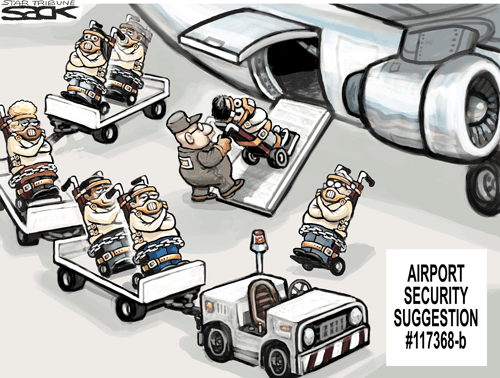
I’ve got a lot of catching up to do from my two week baby hiatus, so forgive me if my commentary is not as immediately topical as it should be. I was not so cocooned that I was unaware of the brouhaha surrounding the plot uncovered in England or the subsequent clamp down in security. The way things are going, within a few years we’ll all have to change out of clothes and into standard issue robes before getting on our planes blindfolded. Patrick Smith, who writes the “Ask the Pilot” column on Salon.com is highly critical of what he perceives to be massive overreaction in airline security (check out his columns from 8/10, 8/17, and 8/25 here: http://dir.salon.com/topics/patrick_smith/). In his words, terrorists don’t even have to actually do anything to cause chaos and panic: they just have to threaten to or talk about doing it.
The rash of plane delays, rerouting, and other snafus that have occurred since the plot was uncovered, plus the arrest and subsequent exoneration of two separate sets of Arabs selling cell phones (no, they weren’t going to blow up the Mackinac Island Bridge) does appear to lend credence to Smith’s critique, which he sums up by saying:
Meanwhile, the ultimate and destructive irony is that we've responded to news of the infiltrated terror plot not with increased confidence -- confidence in knowing that most would-be bombers are unskilled fanatics whose plans are prone to failure, and confidence in our abilities to outwit such people -- but with yet more fright and self-defeat.
In other words, the only thing we really have to fear is how our fear causes us to overreact and cause us major problems.
I’m hard pressed to disagree with Smith, but at the same time, I’m reluctant to pish-posh the terrorist threat as well. Not because I’ve drunk the “clash of civilizations” kool-aid, but because I just don’t know. Some of my existential doubt stems from watching the events of 9/11 from 1,000 miles away. I wasn’t in the states on 9/11 and I have no idea how it felt to be under attack. I do know that I was angry and upset, and was really hoping that some (small) person would pick a fight with me on the bus, so that I could whip someone’s behind as a substitute. Some part of me thinks that if I had been in the US, I would have taken things more seriously. At the same time, some part of me thinks that I’m better off for having avoided the emotional pressure cooker that was the US after 9/11.
I don’t know if there are hordes of “Islamo-fascists” out there with the desire, capability and means to do great damage to America. I know what happened on September 11th and in Bali, Madrid and London. I also know that thousands of Americans and other Westerners have been kidnapped, killed, and otherwise terrorized by Islamic, Arabist, anarchist, and communist terrorists and guerillas since the 1960s without the declaration of global war on terror. I don’t know (besides the scale and geographical location of the events of September 11th) what is so fundamentally different now.
My suspicion is that a large measure of my doubt comes from disbelieving the messengers of doom. Alberto Gonzales and Michael Chertoff and whatever other alarmist Bushite that steps in front of the microphone have long lost credibility with me. I know terrorist threats exist. I also know we’ve stopped a good number of them and that it is patently obvious that the Bush Administration has manipulated the timing and tenor of announcements for political gain. Part of my skepticism has to do with other factors influencing my distrust of the Bush Administration. But it can not all be laid at the feet of lefty paranoia. Remember, Bush had a 90% approval rating after 9/11 and hardly anyone (the Boondocks’ Aaron McGruder and Noam Chomsky are notable exceptions) questioned the rush to war. The politicizing of the war on terror and the headlong, headstrong, and foolish charge into war with Iraq evaporated much of that goodwill in a divisive oven of partisan hate. I remain grateful to the men and women of law enforcement that have kept us safe thus far, but still wonder what’s really going on.
And if I can bring my toothpaste on the airplane this Thanksgiving.
Peace.
Sunday, August 27, 2006
Providence at Provident
For those of you who read my blog who aren’t related to me (that might just be you Mike Doyle), I haven’t posted because my wife just gave birth to our second daughter Anastasia Patricia on August 15th. I’m not so into the networld that I had to do an immediate post to show the world our beautiful little girl, I did it by phone and e-mail. And no, I’m not such an exhibitionist that I have to post pictures of her, either.
But I do want to give much love and respect to the staff of Provident Hospital of Cook County. Because of the University of Chicago Hospital’s decision not to take our form of insurance, we stumbled upon Provident in the hopes of merely getting a pregnancy test to qualify for Illinois’ All-Kids Program of mother-child health insurance. Turns out that Provident is one of the few hospitals in Chicagoland to offer nurse-midwives in their maternity unit. That, plus the friendly staff’s assurance that we would not have to pay out of pocket to deliver our child made Provident the obvious choice.
Provident is a public, Cook County Bureau of Health Services system hospital. Sarah and Anastasia were quite possibly the only white patients. The physical plant of the hospital is not state of the art and the cafeteria is not gourmet. It is clearly an underfunded and overburdened health care institution. With all that being true, we could not have asked for a better experience. The midwives were extremely competent and caring. The nurses were excellent. The support staff, such as the security staff, dietary services staff and just about everyone we ran into throughout the corridors of the hospital combined competence and exemplary customer service skills. I left Provident feeling extremely blessed by a group of people dedicated to providing top-notch service in a challenging environment.
As we near the Cook County Board election and budget battles, I want as many people to know as possible that the money (not) lavished on Provident is money well spent.
Peace
But I do want to give much love and respect to the staff of Provident Hospital of Cook County. Because of the University of Chicago Hospital’s decision not to take our form of insurance, we stumbled upon Provident in the hopes of merely getting a pregnancy test to qualify for Illinois’ All-Kids Program of mother-child health insurance. Turns out that Provident is one of the few hospitals in Chicagoland to offer nurse-midwives in their maternity unit. That, plus the friendly staff’s assurance that we would not have to pay out of pocket to deliver our child made Provident the obvious choice.
Provident is a public, Cook County Bureau of Health Services system hospital. Sarah and Anastasia were quite possibly the only white patients. The physical plant of the hospital is not state of the art and the cafeteria is not gourmet. It is clearly an underfunded and overburdened health care institution. With all that being true, we could not have asked for a better experience. The midwives were extremely competent and caring. The nurses were excellent. The support staff, such as the security staff, dietary services staff and just about everyone we ran into throughout the corridors of the hospital combined competence and exemplary customer service skills. I left Provident feeling extremely blessed by a group of people dedicated to providing top-notch service in a challenging environment.
As we near the Cook County Board election and budget battles, I want as many people to know as possible that the money (not) lavished on Provident is money well spent.
Peace
Subscribe to:
Posts (Atom)